

Each year, our Summer Research Program scholarships bring amazing undergrads into Image X to contribute to real-world health technology projects with us.
In between their experiments and coding sessions, we had a quick Q&A with Hafza Afzal and Jeyson Chuah to get a snapshot of the kinds of projects happening over summer, and the different study backgrounds that are contributing to our projects.
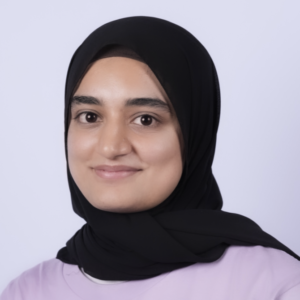
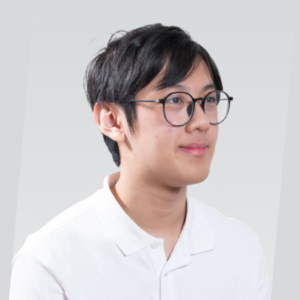
What degree are you currently doing, and why did you choose it?
Hafza: I’m in my final year of Biomedical Engineering. Having experienced healthcare from close quarters, I’ve always felt motivated to work on technology that can genuinely improve the way patients are diagnosed and treated.
Jeyson: I’m studying Advanced Computing (Honours), with a major in computational data science. I chose it because high school graduate me wanted to learn more about Machine Learning and how it could be used to bring greater change in the world.
What are you working on at Image X?
Hafza: I’m working on AI-based image enhancement for ultra-low-field portable MRI, supervised by Dr. David Waddington and Dr. Andrew Phair. We’re developing AI methods to improve image clarity so portable MRI can become a more reliable and widely accessible diagnostic tool.
Jeyson: I am working on the development of a wearable for respiration and cardiac monitoring during CT image acquisition with Dr. Mark Gardner. The wearable is the first of it’s kind that makes use of wireless transmission. It will allow us to monitor the patient’s signals more easily when using rotation-based radiotherapy devices, where cables can get in the way. It would also give us the ability to monitor cardiac motion wirelessly during CT scans, which could help improve the quality of treatment plans.
How would you explain your summer project to your mum?
Hafza: Hospital MRI machines give very clear images, but they’re big, expensive, and not easy to access everywhere. Portable MRI machines are smaller and more affordable, and they can even be used at a patient’s bedside, but the images aren’t as sharp. So this summer, I’ve been working on using AI to improve those images, helping make high-quality MRI scans more accessible for people in smaller hospitals, rural areas, and places where traditional MRI just isn’t practical.
Jeyson: I’m trying to develop a more convenient method for patients to get their heart and breath rate checked during scans.
If you weren’t working with us all summer long, what would you be doing?
Hafza: I traded a short-term exchange for this internship, so I’d probably be exploring Norway right now – but no regrets, this has been worth it.
Jeyson: I’d still be continuing my massive drawing spree that began in the winter break!


Since 2018, our Summer Research Program has been a career starting point for many amazing students. We’re proud to support emerging researchers through hands-on, real-world projects, and we look forward to seeing where their careers in health technology and research take them next!
View the Summer Research Program page to find out about applying for the 2026 round. You can also view other Faculty of Medicine and Health Summer Research Programs.