

Emerging voices in medical physics: seminar series returns for its third year
Image X Institute’s month-long seminar series returns for its third year, curated by A/Prof Tess Reynolds. Bringing together four emerging researchers and clinical medical physicists from leading US institutions, the series explores advances in cancer treatment alongside the education, mentorship and professional engagement shaping the field’s future.
This year’s speakers are Dr Megan Chesal, Grace Minesinger, Taylor Meyers and Dr Pavitra Ramesh. Their presentations span image-guided planning for focused ultrasound treatment of liver tumours, understanding subsequent breast cancer risk in childhood cancer survivors, optimising proton therapy, and building a career of lasting impact in medical physics.
Together, the speakers offer insights into how research can improve patient care, and share perspectives on learning, collaboration and contributing to the medical physics community. Meet this year’s speakers below.
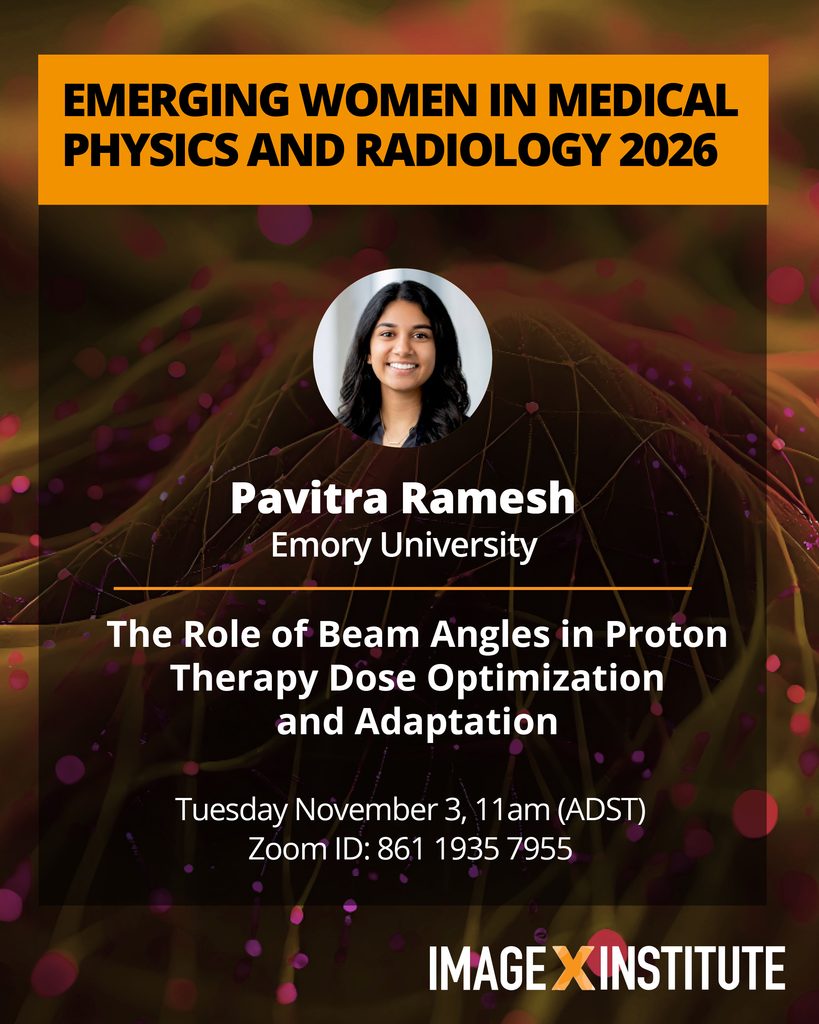
Tuesday November 3, 11am ADST
The Role of Beam Angles in Proton Therapy Dose Optimization and Adaptation
Dr. Pavitra Ramesh,
Emory University Proton Therapy Center
Dr. Pavitra Ramesh is a medical physicist at Emory Proton Therapy Center with clinical and research experience in treatment planning and advanced radiation therapy technologies. She completed her Ph.D. in Physics and Biology in Medicine at the University of California in Los Angeles and her therapeutic medical physics residency at the University of Washington. Her research focuses on proton therapy beam angle optimization, FLASH radiotherapy, and biologically informed treatment planning. She has authored numerous peer-reviewed publications and presented her work at national and international conferences, including AAPM, PTCOG, ASTRO, and FRPT. She is also actively involved in professional service, education, and mentorship within the medical physics community.
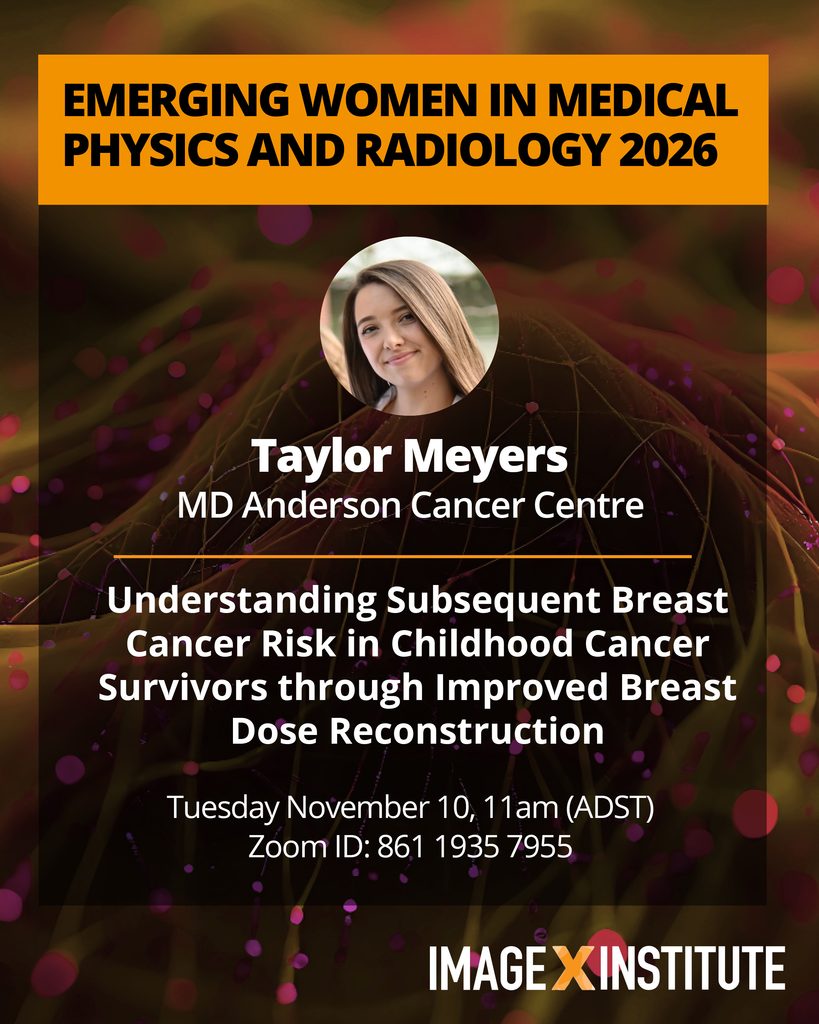
Tuesday November 10, 11am ADST
Understanding Subsequent Breast Cancer Risk in Childhood Cancer Survivors through Improved Breast Dose Reconstruction
Taylor Gwen Meyers, M.S.
The University of Texas MD Anderson Cancer Center UTHealth Houston
Taylor Meyers is a Ph.D. candidate in Medical Physics at The University of Texas MD Anderson Cancer Center UTHealth Houston Graduate School of Biomedical Sciences. She earned her B.S. in Physics from California State Polytechnic University, Pomona and M.S. in Medical Physics from the University of Oklahoma Health Sciences Center. Her research develops computational methods to reconstruct historical radiotherapy breast doses in female childhood cancer survivors using development stage-specific breast models to investigate how dose and dose-volume metrics influence subsequent breast cancer risk.
Her work has received multiple awards, most recently first place in the John R. Cameron–John R. Cunningham Early Career Investigator Symposium at the 2026 AAPM Annual Meeting. She is also a recipient of the American Legion Auxiliary Fellowship in Cancer Research, Winter Institute for Medical Physics Early Career Scholarship, and Childhood Cancer Survivor Study Career Development Trainee Award, and was selected for the inaugural PhiRO Reviewing and Editorial Mentorship Initiative cohort. Her professional service includes the AAPM Students and Trainees Subcommittee, Southwest Chapter of AAPM Planning Committee, and AAPM Recommendations to Address Medical Physics Supply Working Group. She plans to pursue a therapy medical physics residency and career as a clinical medical physicist with continued involvement in research, mentorship, and professional service.
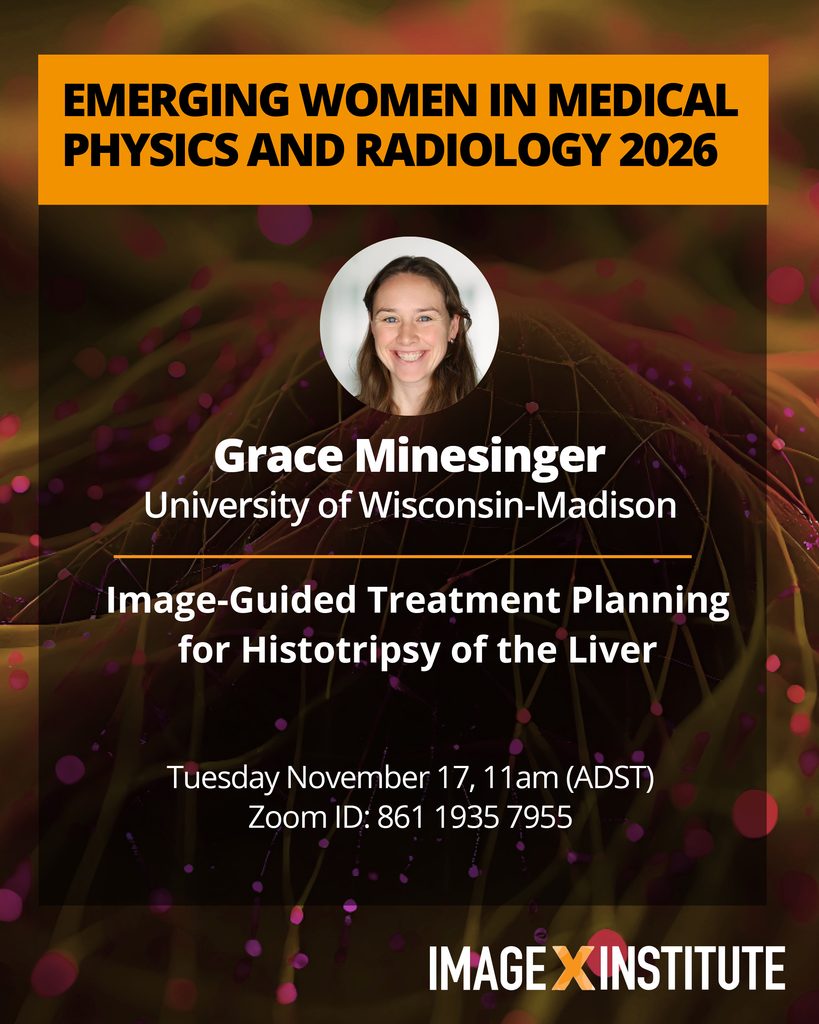
Tuesday November 17, 11am ADST
Image-Guided Treatment Planning for Histotripsy of the Liver
Grace Minesinger
University of Wisconsin-Madison
Grace Minesinger is a 5th year medical physics PhD student at the University of Wisconsin-Madison. Grace earned her BS in physics from UVA and her MS in medical physics from UW-Madison. Grace is now working in the Image Guided Interventions Lab with Dr. Wagner, Dr. Speidel, and Dr. Laeseke to advance the treatment planning workflow for histotripsy – an emerging focused ultrasound therapy currently used for treating liver tumors. Her work focuses on utilizing interventional imaging for guiding histotripsy, as well as leveraging tissue biomechanics to predict organ deformation to facilitate treatment planning. Grace is passionate about making learning feel accessible and enjoys sharing her work. She has performed numerous demonstrations of histotripsy to visiting groups, ranging from middle schoolers to visiting professors. Looking ahead, Grace is excited to pursue a postdoctoral position in 2027 to gain mentorship and teaching experience, as well as further advance the field of focused ultrasound interventions.
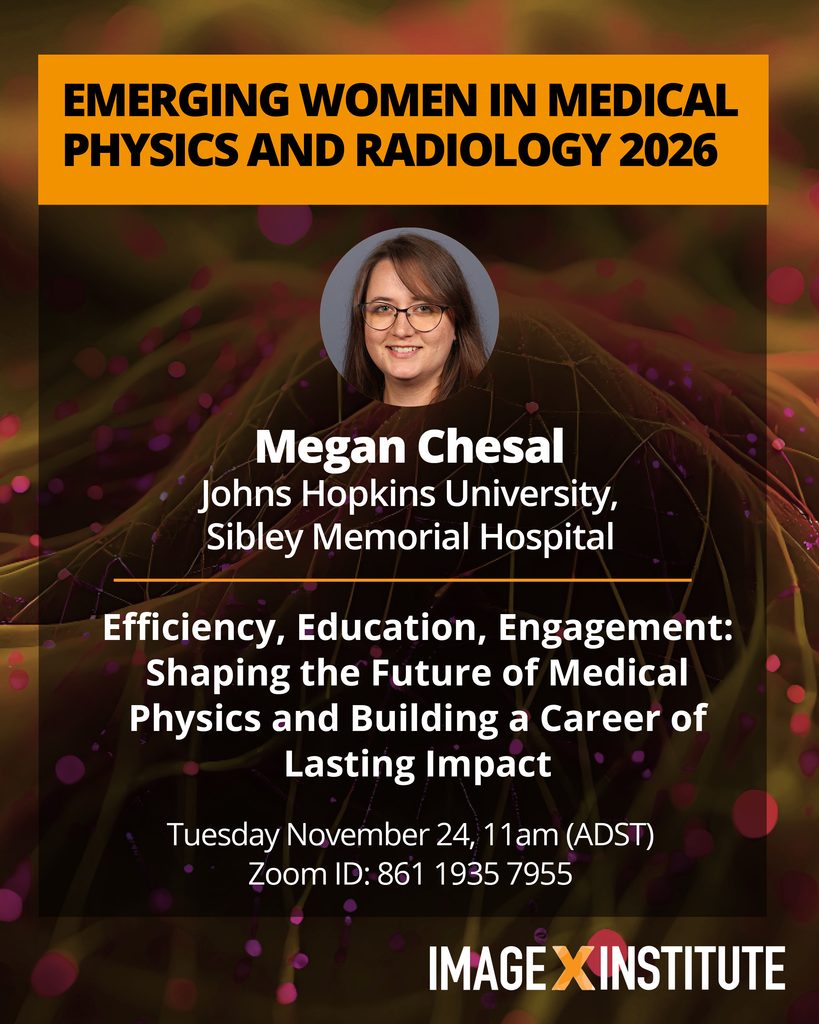
Tuesday November 24, 11am ADST
Efficiency, Education, Engagement: Shaping the Future of Medical Physics and Building a Career of Lasting Impact
Megan Chesal, PhD, MS
Johns Hopkins University, Sibley Memorial Hospital
Megan Chesal grew up in a small town in Northwest Louisiana, USA; she attended Louisiana State University in Baton Rouge earning a Master’s in Medical Physics and a PhD in Physics. Her graduate research involved the fabrication of modulation devices for use in heavy ion beamlines to emulate the space radiation environment for animal studies. Her work investigated the dose subjects may receive while on mission, and the validity of animals to human astronaut outcomes. Dr. Chesal completed a therapeutic physics residency at the University of Pennsylvania in Philadelphia, Pennsylvania, where she focused on device implementation and improving clinical workflows and efficiency. Throughout her career, Dr. Chesal has advocated for positive change within the field in the hopes of further diversifying the community. Working towards this goal, she has developed sessions for increased student involvement at regional chapter and annual AAPM conferences. Continuing her support of those entering the field, she serves as the chair of the Working Group on Student and Trainee Research (WGSTR) and is on the review board for the Expanding Horizons Travel Grant. Dr. Chesal currently serves as an instructor and medical physicist at Johns Hopkins University and the Proton Center at Sibley Memorial Hospital in Washington DC.