
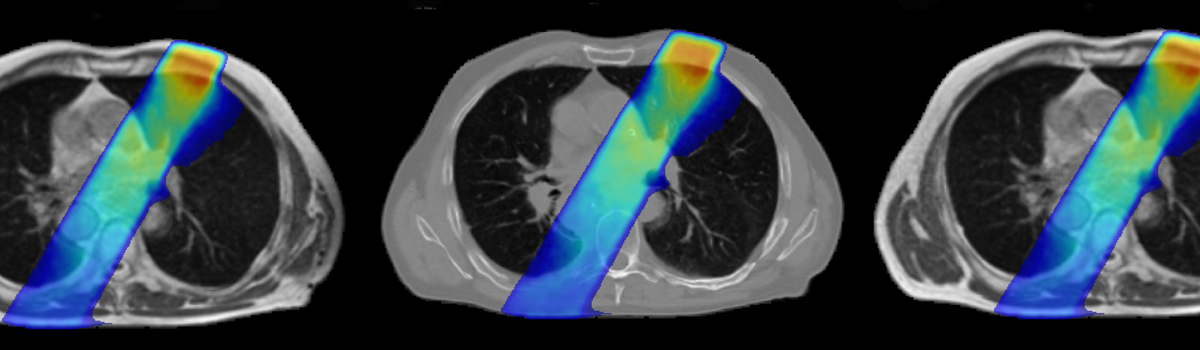
An Image X team has placed first in both photon dose calculation categories of the international DoseRAD2026 Grand Challenge, achieving the competition’s leading combination of accuracy and speed.
The challenge brought together research teams from around the world to test their algorithms on a common dataset, with submissions independently ranked using standardised performance measures. It attracted 46 teams and 565 algorithm submissions across four photon and proton dose calculation categories.
Organised by medical physicists and radiotherapy researchers from institutions across Germany, the Netherlands, Switzerland and Sweden, DoseRAD2026 was hosted on the Grand Challenge platform in association with the Medical Image Computing and Computer Assisted Intervention (MICCAI) Society
The team (Chen Cheng, David Waddington, Emily Hewson, James Grover and Michael Ferraro) won the photon dose on CT and photon dose on MRI tasks.
For Chen (pictured below) and the Image X team, the competition offered an opportunity to test their work against an international field.
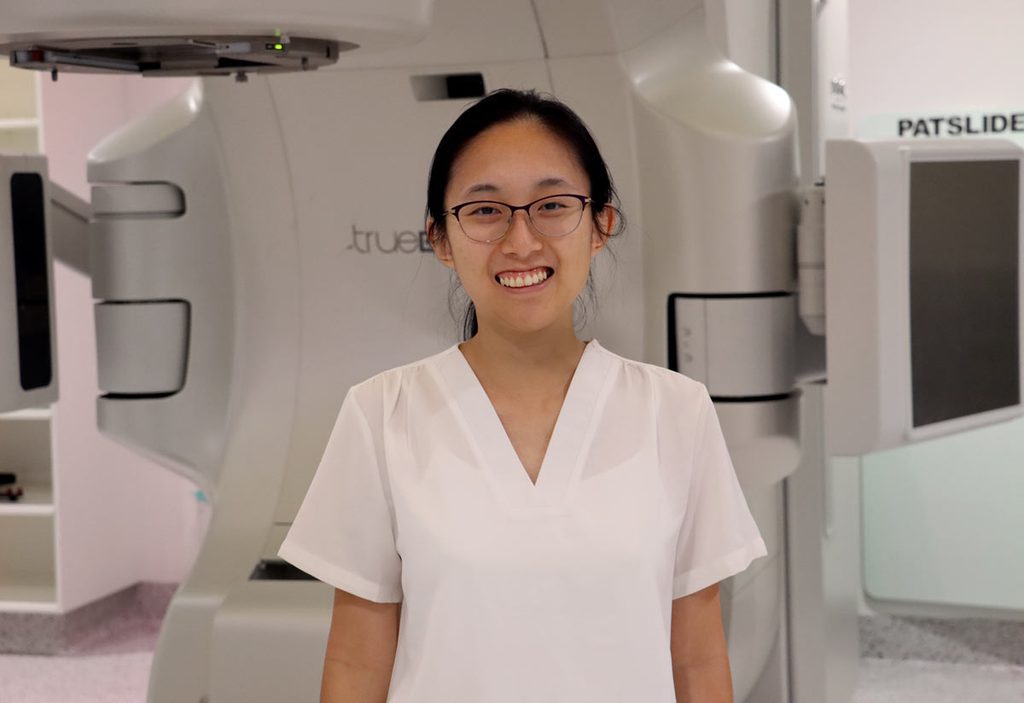
“My research focuses on monitoring patient motion in real time as the patient’s anatomy moves, and being able to accumulate delivered radiation dose in real time is an important next step,” Chen said.
“Image X researchers have a strong track record in developing real-time dose guidance technologies, and this challenge provided a rare opportunity to compare our method fairly against international teams using a common benchmark.”
The team’s deep learning model uses the patient’s medical image and treatment beam information to predict where radiation dose is deposited inside the patient’s body. The model achieved the competition’s best combination of accuracy and speed across both photon-dose categories, calculating the radiation dose from a complete treatment in just 23 seconds on a standard mid-range graphics processor.
The team endured some familiar challenges for researchers working with high-performance computing, navigating computing cluster job scheduling, and discovering that jobs had crashed unexpectedly. There were plenty of highlights along the way too –
“It was particularly exciting to see the team’s discussions and individual contributions come together in a method that ultimately placed first in both photon-dose categories.” says Chen.
The team will make its code publicly available through the Image X GitHub repository later this month. From there, the researchers hope to continue developing the approach for faster treatment planning, online adaptation and, ultimately, real-time dose-guided radiotherapy.
The team’s submission paper is available as a preprint.