

We’re developing methods to expand what Magnetic Resonance Imaging (MRI) can do, and where it can go.
Led by Dr David Waddington, the lab’s projects span MRI-guided radiotherapy, low-field and portable MRI, and real-time speech imaging. The lab utilises MRI physics, artificial intelligence, and hardware development to move technologies from the lab into clinical use, working closely with hospital, industry, and international partners.
Projects
MRI offers unmatched soft-tissue contrast during cancer treatment, enabling radiation beams to adapt in real time to tumour motion and changing biology. Image X played a central role in the Australian MRI-Linac Program, a national research initiative that developed MRI-guided radiotherapy technologies now being deployed to clinical systems. Our group builds the real-time MRI reconstruction, AI-driven motion tracking, and adaptive radiotherapy methods that make this possible, with clinical translation supported by access to the Elekta Unity MRI-linac at St Vincent’s Hospital.
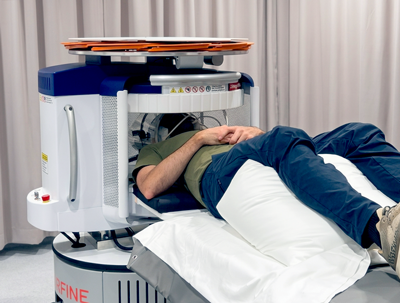
70% of the world’s population has no access to MRI. Conventional scanners are too expensive, too heavy, and too demanding of infrastructure to reach most patients who need them. We are building the technologies that change this. Our work spans AI-based image reconstruction and enhancement, nanoparticle contrast agents that boost sensitivity at ultra-low field, and hyperpolarization methods including 13C MRI that unlock new contrast mechanisms for cancer imaging. We collaborate with Hyperfine, Massachusetts General Hospital, and other international partners to translate these advances into accessible, portable systems.
Real-time MRI makes the inside of speech visible. By capturing the rapid, coordinated motion of the tongue, lips, and airway that produces sound, our methods open new possibilities for understanding and diagnosing speech production disorders. We work with collaborators in speech pathology (Health Sciences) to apply these techniques in clinical and research settings.
Systems
We’re working with a range of MRI systems based at the University of Sydney and at the sites of our clinical collaborators.
- Hyperfine Swoop portable MRI (0.064 T), University of Sydney
- Home-built low-field MRI system, University of Sydney
- Preclinical 7T MRI (MR Solutions), University of Sydney
- Elekta Unity MRI-linac, St Vincent’s Hospital
- 3T Siemens Cima.X, University of Sydney
- 3T Siemens scanners at Liverpool Hopsital and Westmead Hospital
Research
View Image X projects
Team
David Waddington
Thomas Boele
Andrew Phair
James Grover
Michael Ferraro
Samuel Murphy
Alumni
Caterina Brighi
Shanshan Shan
Frédérique van Gameren (Visiting Researcher)
Win Lynn (Honours)
Alicia Sanggolo (Honours)
Declan Langreiter (Honours)