
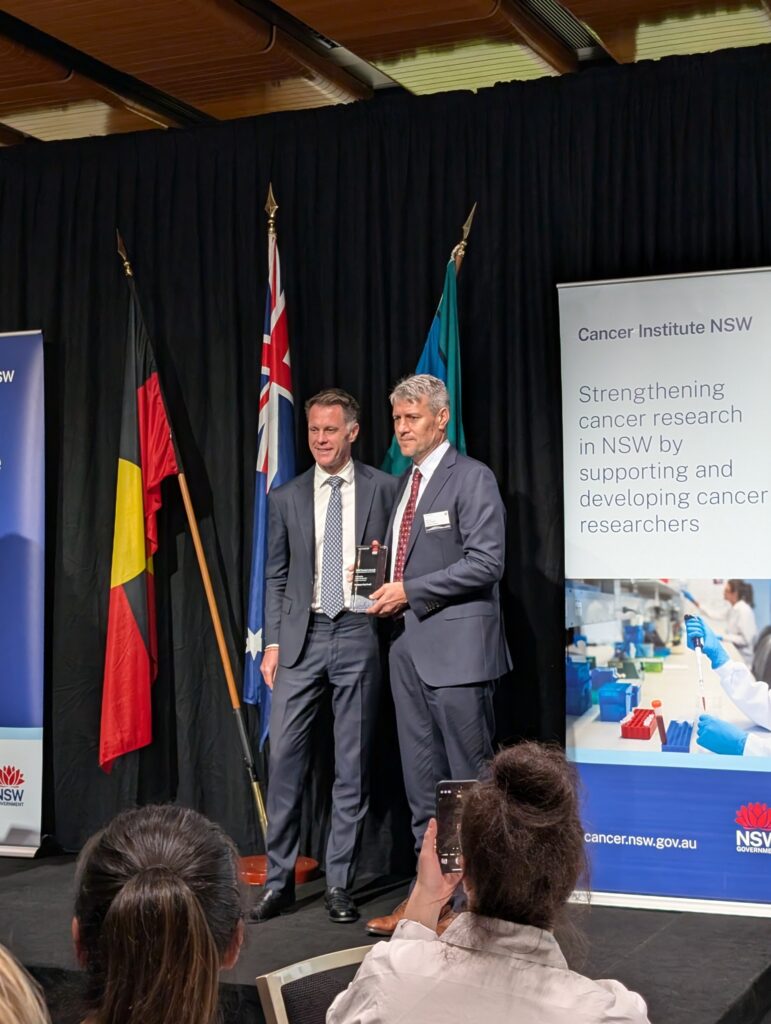
Professor Paul Keall, Director of the Image X Institute, has been awarded the 2025 NSW Premier’s Award for Outstanding Cancer Researcher of the Year.
The award recognises his exceptional leadership in advancing precision cancer imaging, radiation therapy innovation, and equitable access to care across New South Wales. The NSW Premier’s Awards for Outstanding Cancer Research, presented annually by the Cancer Institute NSW, celebrate researchers whose commitment and discoveries have significantly improved cancer treatment, prevention, clinical trials, and health outcomes across the state. Established in 2006, the awards are the leading NSW program recognising excellence and innovation in cancer research.
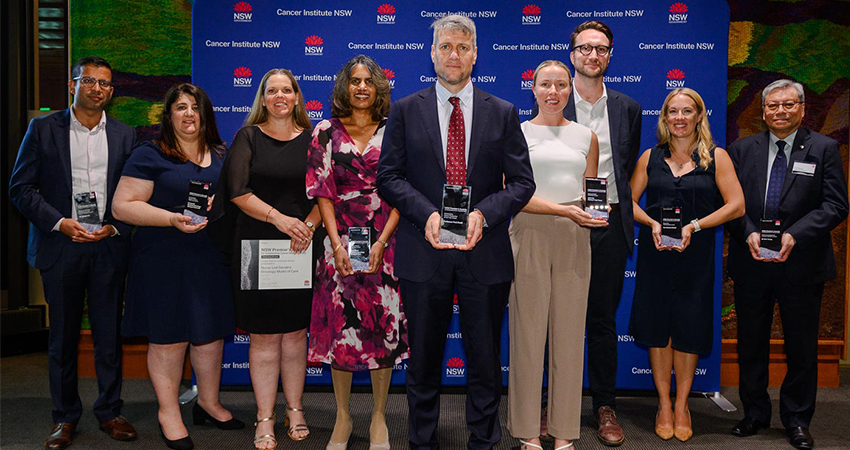
This marks an extraordinary week of recognition for Professor Keall, who also received the NSW Premier’s Prize for Leadership in Innovation just days earlier. Together, these honours reflect the depth of his scientific contributions, the translational strength of his research program, and his long-standing commitment to delivering better outcomes for patients.
Transforming Cancer Care Through Innovation
Professor Keall’s work exemplifies value-based, patient-led innovation: technological solutions that are more precise, faster, and more accessible—particularly for communities historically underserved by complex cancer care. His research harnesses mathematics, physics, engineering, and artificial intelligence to generate practical, scalable advances that strengthen NSW’s capability and global competitiveness.
A hallmark of his program is its focus on equity. Partnerships with cancer consumers ensure that community perspectives—particularly Aboriginal, regional, rural and remote voices—drive research priorities. Collaborators such as Miriam Cavanagh, a lecturer in Aboriginal and Torres Strait Islander Health, and Lee Hunt, a regional cancer advocate, play key roles in shaping culturally safe and community-centred research.
This approach aligns directly with the NSW Cancer Plan, which identifies Aboriginal people, regional and rural communities, and individuals from lower socioeconomic backgrounds as priority populations. Despite national progress, significant disparities persist: Aboriginal and Torres Strait Islander people experience a 40% lower five-year cancer survival rate, and are twice as likely to be diagnosed with—and die from—lung cancer. Addressing these inequities remains central to the Image X mission.
Impact Through Clinical Translation
Professor Keall and his team have pioneered several technologies now improving patient care in Australia and internationally.
- CT Ventilation Imaging – invented and clinically translated by the Image X team – enables radiation oncologists to identify the healthiest regions of a patient’s lungs and spare them during treatment. Unlike nuclear medicine or MRI-based ventilation imaging, CT ventilation is cost-effective and widely accessible. The technology is now licensed, in clinical use, and improving outcomes for patients across NSW, including in regional centres such as Dubbo and Orange.
- Kilovoltage Intrafraction Monitoring (KIM) – a real-time tumour-tracking technology – allows prostate cancer patients to receive the same effective radiation dose in just five treatment sessions, instead of 40. The technology was evaluated in the TROG 15.01 SPARK trial, including patients from regional NSW. KIM is now being commercialised by NSW company SeeTreat, and is expected to be available to nearly half of the world’s prostate cancer radiation therapy patients by 2026.
These innovations form part of a substantial translation pipeline that includes 42 patents, 20 licences, five global products, and 13 clinical trials—eight of them first-in-human studies. Partnerships with Siemens, Varian, Elekta, 4D Medical and other industry leaders are bringing NSW-developed technologies to global markets.
Leadership, Mentorship and Global Influence
Across his career, Professor Keall has made enduring contributions to the global medical physics and radiation oncology community.
He has supervised 19 PhD and 12 MSc candidates as lead supervisor, co-supervised 20+ additional students, and mentored more than 39 postdoctoral researchers. His mentees now hold academic and clinical positions at leading institutions, including MD Anderson Cancer Center, University of Maryland, University of Wisconsin, University of Virginia, and the University of Sydney, and have secured 11 major fellowships in the past six years.
Professor Keall has held major leadership roles, including Director of Radiation Physics at Stanford University and Director of the Image X Institute. He has chaired international guideline groups that shape clinical practice, including AAPM task groups and the ICRU report on MRI-Linac image-guided radiotherapy, and has contributed more than 400 publications with over 32,000 citations.
A Well-Deserved Honour
The Image X Institute congratulates Professor Keall on this outstanding achievement. His leadership continues to drive significant advances in cancer care—ensuring new technologies reach the patients and communities who need them most, and positioning NSW as a global leader in cancer innovation.
In the Media
Cancer Institute NSW
- Awards Announcement: Medical physicist wins state’s top cancer research prize
- Profile: Winner of the 2025 Outstanding Cancer Researcher of the Year Award